Satokin Co., Ltd.
President / Representative Director Yasuyuki Otsuka
Takasaki city, Gunma prefecture | Manufacturing | ~100 employees
Copper alloy and aluminum alloy casting, aluminum heat treatment, and other related products
Feb. 10, 2026
What We Learned After Four Engineers Left — Satokin’s “Mutual Selection” Approach to Hiring Foreign Engineers
“We’re short-handed.”
That single line from Satokin’s president, Mr. Otsuka, captures the reality facing small and mid-sized manufacturers in rural Japan. Even with open recruitment, it’s hard to attract applicants. The Japanese hiring market favors job seekers: people flow to employers with better conditions, and the reasons to “go out of one’s way to work in manufacturing” have grown thinner. On top of that, Satokin is located away from central Takasaki City, which is a disadvantage for commuting as well. That’s why the company decided to pivot toward utilizing foreign talent.
However, what President Otsuka emphasizes is that “hiring isn’t the finish line.” With language barriers, the burden of onboarding, and retention concerns—an area full of uncertainties—he believes the company must place “design” first. And the starting point of that design was surprisingly simple: changing the way they viewed hiring itself.
The Setback: Bringing in “Top Talent” from Outside Didn’t Fit
The background to Satokin’s need for engineers was that the number of foreign workers on the shop floor had increased, and they also needed people who could coordinate and lead. In casting, design and engineering are the core; work requires CAD skills and an analytical mindset. But as President Otsuka puts it, “To be honest, there are hardly any Japanese university graduates who choose to come work in a casting shop floor.” So the company decided to try hiring foreign engineers.
At first, they used an agency that focused on candidates from so-called top universities. But it didn’t work out: “They didn’t match our company’s level. Their aspirations—our values—just didn’t align.” Japanese manufacturing often involves spending time on the shop floor first, learning through hands-on experience. But they couldn’t endure that “one year,” and resignations followed with the sentiment of “This isn’t what I signed up for.” In the end, four people left, and it became clear they needed to rethink their approach.
The Turning Point: From “The Company Chooses” to “We Choose Each Other”
The turning point was Satokin’s encounter with Zuitt. What President Otsuka found compelling was that it wasn’t only the company selecting candidates—candidates also learned about the company and applied because they felt “I want to work here.” It was a model of “mutual selection.”
“People who join after understanding what they’re getting into are more likely to stay than those who come without understanding and then leave.”
That single sentence is a major hint for business leaders considering foreign hiring. What matters is not “academic pedigree,” but whether the candidate’s aspirations align with the company. To confirm that alignment, it’s essential to create a process where candidates can actually see the workplace and the job.
Three Hiring Criteria: “Aspiration,” “Commitment to Develop,” and “Expectation Alignment”
Organizing President Otsuka’s comments, Satokin’s hiring criteria can be summarized into three pillars:
- Do their aspirations (values) align?
More important than how prestigious their university is: what do they want to do, and what can they endure? - Does the receiving side have the resolve to “give and develop”?
There is no such thing as someone who will “just perform on their own because they’re talented.” - Are expectations aligned?
Has the person accepted and agreed to the time needed to understand the shop floor?
“Companies that overestimate the other side will fail, I think.”
This is also a management stance: not blaming “hiring mistakes” solely on an individual’s ability.
Onboarding Design: Reduce the Language Barrier Through “Daily Communication” and “Visualization”
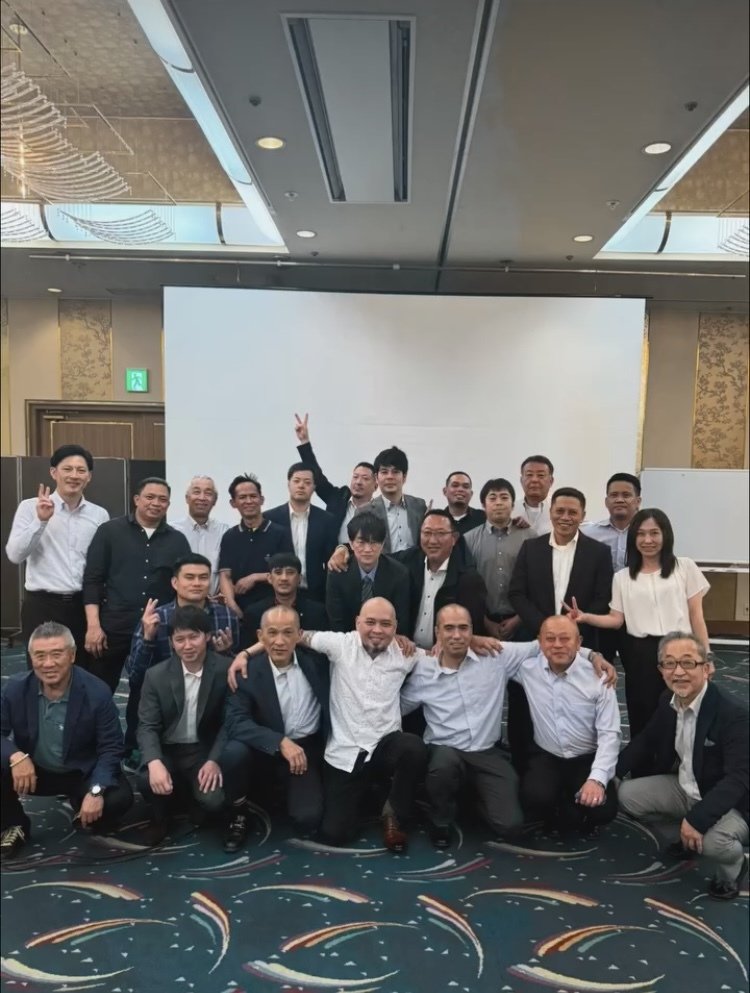
When it comes to language barriers, Satokin prioritizes daily operations over special systems. Every morning at the daily assembly, President Otsuka speaks for about 10 minutes, mixing English and Japanese so foreign employees can understand. In addition, once a year, the company holds a policy presentation at a hotel, explains sales performance, and encourages questions as well.
“I don’t want it to be me talking one-sidedly—I want them to understand that ‘we’re doing this together.’”
Evaluations are conducted once a month. If evaluations are only done every six months, people forget details, and the gap between self-evaluation and others’ evaluations grows. So Satokin evaluates frequently, “visualizes” progress by accumulating results, leaves written comments, and clarifies “what to do to improve.”
Daily assembly + annual all-hands + monthly evaluations—this set is how Satokin communicates the “Satokin way.”
Retention Starts with Daily Life: Licenses, Cars, Moving, and “The Right Order to Win Hearts”
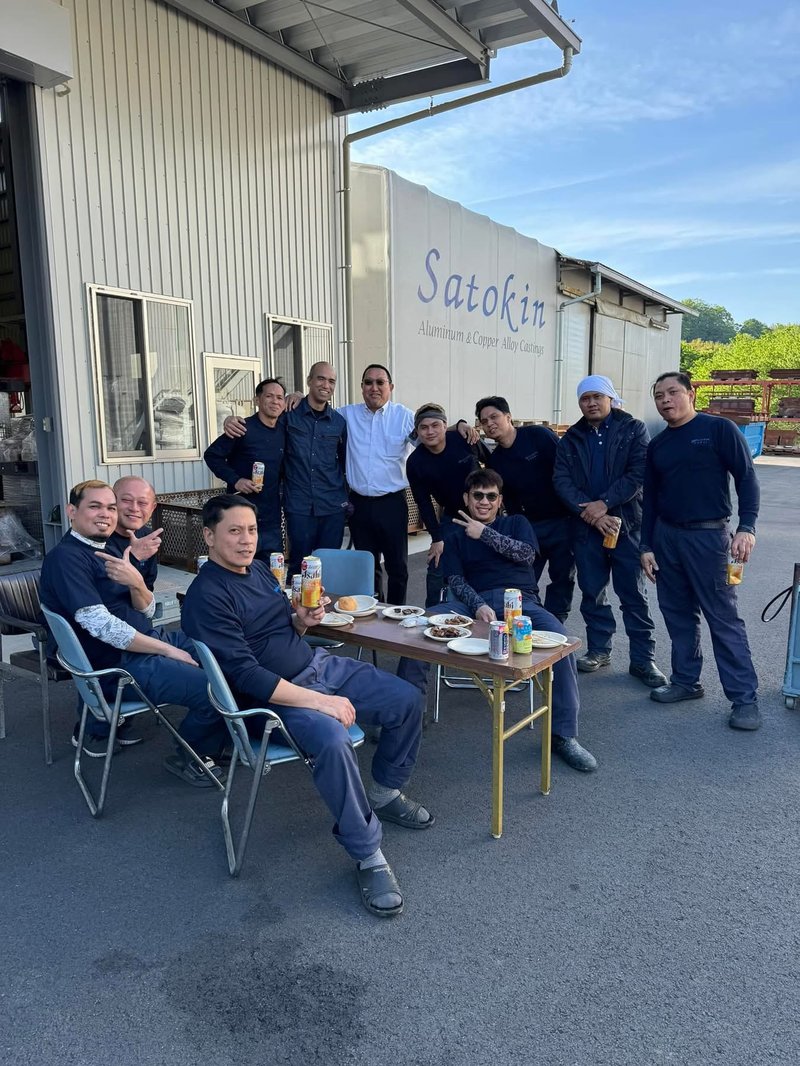
When the topic shifts to retention, President Otsuka is definitive: “We start from daily life—together.” Since getting a driver’s license broadens a person’s world, the company supports employees in obtaining one. If they can’t afford a car, Satokin creates time windows when they can use a company vehicle. The company also helps with moving. At year-end, after a big cleanup and window washing, everyone gathers for yakiniku.
A symbolic example is the start-of-day routine. Official start time is 7:50 a.m., but the president arrives at 6:30 a.m. to open up, turn on the heat and lights, and prepare the factory. After he kept doing this, the Filipino members began arriving even earlier than him to help with preparation. Because these contributions can easily be overlooked, he makes sure to acknowledge them in meetings by putting it into words: “They’re doing things like this for us.”
“It doesn’t work if you only scold them about work. First support them outside of work, get their feelings oriented toward the company, and then talk about work. The order matters.”
In the end, “retaining people without increasing the burden on the shop floor” may come down to not breaking this order.
To Companies Considering This Next: “If You Want Something, the Company Has Work to Do Too”
Hiring foreign engineers isn’t only about the hiring method. President Otsuka closes with this:
“We have things we want, but if we want them, the company has things it needs to do too. Start from daily life—together. Without the resolve to take even more care of them than you would Japanese employees, it’s difficult to accept them.”
It’s natural to feel anxious. That’s exactly why designing the onboarding first—
- expectation alignment (mutual selection),
- daily communication (morning assembly),
- visualization (monthly evaluations), and
- support for daily life—
reduces the probability of failure.
If you want to organize how to proceed with foreign engineer hiring and how to build an onboarding design tailored to your company’s situation, please feel free to reach out—starting with an information exchange is also welcome.