
ARIZONO ORTHOPEDIC SUPPLIES CO.,LTD.
President / Representative Director Hisashi Arizono
Kitakyushu City, Fukuoka Prefecture | Manufacturing | 100 employees~
Prosthetics, Orthotics, Wheelchairs, Seating and Positioning Systems, Rehabilitation Equipment, Materials, Assistive Products, and Medical Devices.
April 29, 2026
Hospitality and feedback: The keys to fostering initiative in global talent.
Many small and medium-sized enterprises (SMEs) in regional areas are hesitant to hire foreign engineers, fearing that "language barriers will cause chaos on-site" or "the burden on supervisors will become overwhelming."
The case of ARIZONO ORTHOPEDIC SUPPLIES CO.,LTD. demonstrates that initiative is not merely a personality trait—it is something that can be cultivated through the right onboarding environment. The keys to success were "Omotenashi" (hospitality) to ensure a secure start and action-oriented feedback that drives continuous progress.
"Everyone is so kind"—The foundational groundwork laid by Arizono Orthopedic Manufacturing.
The three engineers from the Philippines—JL, Lyra, and Ruby—all spoke with one voice: "Everyone is so kind."
However, what they truly valued was more than just kindness. It was a structured support system: Mr. Arizono clearly demonstrated the company’s welcoming stance; Mr. Hirano explained the significance of on-site training and how it connects to their future roles; and Ms. Yoshimura provided hands-on support for their daily lives—from housing and shopping to setting up bank accounts and phone plans. Furthermore, the General Affairs department established a Monday and Friday routine where staff took turns assisting with Japanese language practice and confirming essential updates.
The crucial point here is that this "Omotenashi" was not merely the result of individual goodwill, but a deliberately designed framework for the initial onboarding phase.
Mr. Kato, the CEO of Zuitt, observed that during the first three months in Japan, simply working an eight-hour day imposes a massive cognitive and physical load due to the unfamiliar language and environment. In fact, there were moments when the engineers felt anxious about living expenses before receiving their first paycheck.
By proactively reducing these "life anxieties," the company effectively supported their ability to learn on-site and ensured long-term retention.
The real barrier was not Japanese language proficiency itself, but rather technical terminology and "company-specific jargon."
The challenge identified at ARIZONO ORTHOPEDIC SUPPLIES CO.,LTD. was not a simple case of "not knowing Japanese." The real difficulty lay in technical terminology, Kanji, the natural speed of conversation between native speakers, and the specific "internal language" unique to each department.
Even when supervisors spoke slowly to the engineers, the engineers would lose the context as soon as Japanese colleagues began talking to one another at a normal pace. Furthermore, the CAD software manuals were primarily in Japanese, and they were constantly being introduced to new product names and manufacturing processes.
To address this, the company and Mr. Kato, the CEO of Zuitt, set a clear and concise goal: within the first three months, the engineers should "understand 70% of work instructions given in simple Japanese."
To achieve this, the schedule included four hours of Japanese lessons per week (two-hour sessions twice a week), plus an additional four hours dedicated to preparation and review. On the shop floor, they organized glossaries of essential terms in Japanese, using translation apps only as a secondary aid. During factory training, whenever an unfamiliar word appeared, the staff would demonstrate the action and write the word down; the engineers would then take notes and actively use those words in their daily reports the following day.
By identifying exactly which words are necessary, Japanese language study shifts from "learning for the sake of learning" to a direct tool for the job.
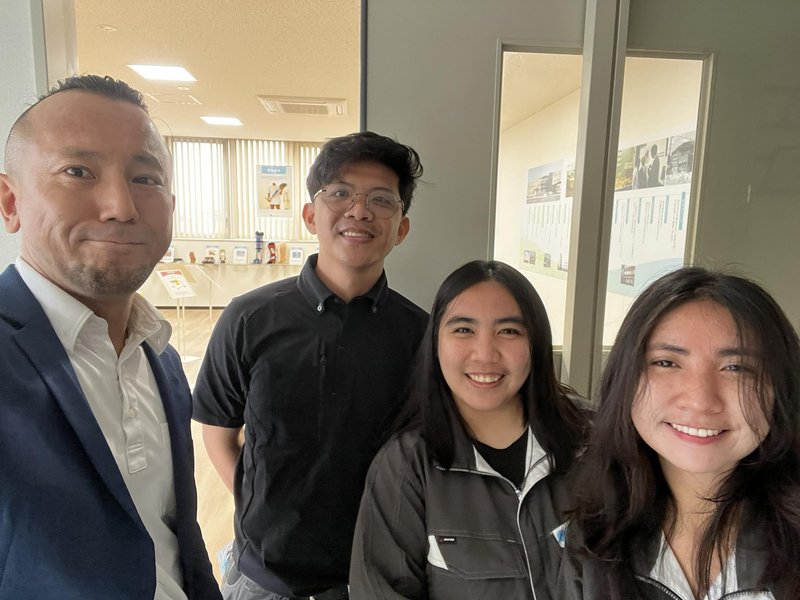
The mutual support among the three was a clear strength. Precisely because of this, it was essential to design a system that did not rely solely on JL.
The three shared a strong bond, supporting each other both in their private lives and at the workplace. This solidarity is a massive source of strength when starting a job in a foreign country. However, on the shop floor, a clear pattern emerged: because JL was the most fluent in Japanese, the tasks of explaining and confirming instructions tended to fall disproportionately on him.
While this was a natural division of labor for the team, it is rarely perceived as sufficient in a Japanese workplace to have "just one person who can speak." From the perspective of the staff on-site, it becomes difficult to see what Lyra and Ruby truly understand or what concerns they might have.
To address this, Mr. Hirano encouraged the three of them, saying: "As future leaders in technology and product development, please write down your own thoughts and observations—it’s okay to make mistakes."
The goal was not to disrupt their teamwork. Rather, it was to share a key premise: while continuing to support one another, having each individual respond in their own words is what is recognized as "initiative" in a Japanese workplace.
What sparked their initiative was feedback that highlighted "what they can do."
A particularly insightful aspect of ARIZONO ORTHOPEDIC SUPPLIES CO.,LTD.’s approach was the shift in stance: prioritizing "checking the flow" over "intensive teaching."
Instead of trying to teach every single word, they conducted brief checks to see if those words were retained. Rather than micro-managing the study process itself, they monitored whether the habit was continuing and if the language was being applied in actual work. This mindset is essential for maintaining the system without placing an overwhelming burden on the staff in charge of onboarding.
Another vital element is never ending a conversation with only points for improvement. All three engineers were diligent in their studies and wrote detailed daily reports. However, it is difficult for anyone to stay motivated without a tangible sense of progress. This is why it is essential to provide individual feedback, such as, "You’ve done this part very well," or "This is an excellent observation."
By verbalizing their strengths first before moving on to the next challenge, the company creates a sequence that bridges the gap between self-confidence and proactive action.
Turning "I don't understand" into a step forward with one simple phrase: "Do you mean it’s like this?"
The most replicable innovation in this case study was the method of confirmation. When someone is anxious about their language skills, they tend to get stuck at "I don’t understand" or "Could you repeat that, please?" However, these phrases make it difficult for the person giving instructions to know exactly what needs further clarification.
To overcome this, JL shared a specific technique with the other two engineers: instead of staying passive, they should paraphrase the instruction in their own words—asking, "Do you mean it’s like this?" or "So, should I do this next?"
This method aligns perfectly with the Filipino cultural value of respecting a supervisor's time, while also making it much easier for the Japanese staff to pinpoint necessary corrections. Simultaneously, the supervisors shifted their approach: instead of asking "Do you understand?" (a Yes/No question), they began using open-ended questions like "What will you prepare next?" or "How did you interpret that explanation?" This naturally reveals any areas where the understanding is still shallow.
Initiative is not about changing one's personality. It is only when there is an environment where employees feel safe to ask questions, have a structured framework for confirmation, and receive meaningful feedback that "initiative" finally manifests as action.
Looking toward the future for these three, President Arizono says: