
Yanagisawa Iron Works Co., Ltd.
Representative Director Yasutaka Yanagisawa
Kazuno City, Akita Prefecture | Manufacturing | ~100 employees
Manufacture of drilling rods, casing equipment, and industrial components. Fabrication of large-scale steel structures, including architectural frames, bridges, and steel towers.
March 20, 2026
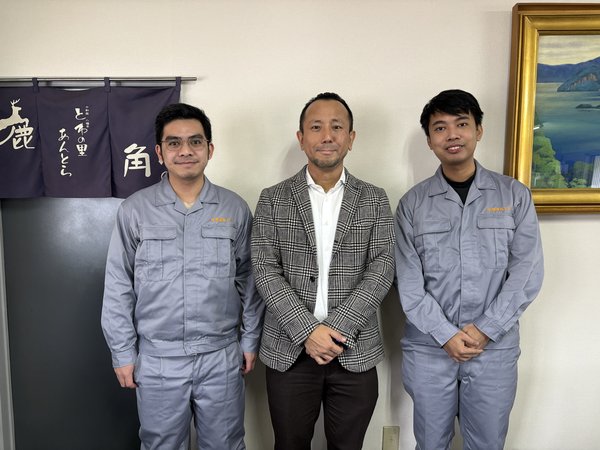
Many companies are interested in hiring foreign engineers but hesitate to take the first step, burdened by concerns over language barriers, workplace strain, and long-term retention. At Yanagisawa Iron Works in Kazuno City, Akita Prefecture, it has been just about one month since they welcomed two engineers from the Philippines. Exploring their early progress revealed a striking reality: the real work begins only after the hiring process is complete. Success is not just about assessing technical skills—it is about how you design the first few months of integration. This crucial early stage determines whether a new hire becomes a long-term asset or leaves the company prematurely.
Key Points of This Article
- Onboarding is the Key to Retention: The post-hire design is more influential than the hiring decision itself.
- The "Foundation-First" Rule: Focus on stabilizing life and work habits during the first 90 days.
- Divisional Support: Ensure long-term success by separating administrative, managerial, and educational support.
About Company & Speakers
Based in Kazuno City, Akita Prefecture, Yanagisawa Iron Works Co., Ltd. is a comprehensive manufacturing firm overseeing every stage of production—from technical drawing and estimation to final fabrication.
In this feature, we visited their facility just one month after the arrival of two engineers from the Philippines. The story is told primarily through the perspective of the General Affairs representative, along with insights from the President and the Onboarding Support coordinator. Together, they discuss the practical application of their "integration-first" philosophy and the real-world steps they are taking to ensure long-term success for their global talent.
Envisioning the Next 5 to 10 Years: Hiring for the Future, Not Just for Today.
What struck me most during this interview was that the roles expected of the two engineers extend far beyond their immediate tasks. President Yanagisawa shared his vision for their future with clarity and ambition.
“Initially, they will focus on technical drawing. In time, they will move into cost estimation, and eventually, oversee the entire fabrication process,” he explained. “Looking further ahead, I want them to engage in technical discussions directly with our clients, leading negotiations and securing new orders.”
In essence, while their journey may begin with CAD, the company’s ultimate goal is not to produce mere "draftsmen." They are expected to become integral members of the Technical Sales Department, taking on responsibilities that span from material procurement and client relations to managing the entire project workflow.
Furthermore, given the company's involvement with drilling equipment and international manufacturers, there are high expectations for them to thrive as multilingual technical experts—leveraging both their engineering skills and their proficiency in Japanese and English to bridge global gaps.
"In the future, I want them to engage in technical discussions directly with our clients, leading negotiations and securing new orders." — Representative Director Mr. Yanagisawa
Our recruitment is not about filling short-term gaps; it is a strategic investment looking 5 to 10 years into the future. Because of this long-term vision, the initial months are not viewed as a period for "immediate return on investment." Instead, they are intentionally positioned as a critical phase for nurturing talent and building the foundation for them to become a core part of our workforce.
Prioritizing the Foundation Over Immediate Results in the First Three Months
This philosophy is consistently reflected in the guidance provided on-site. As one team member explains: "Right now, they are focusing on learning how to create technical drawings," and "The idea is to have them master CAD so they can understand the essential groundwork of our operations."
Rather than rushing them into client-facing roles or external negotiations, the company intentionally prioritizes their understanding of the fundamentals: drawings, materials, and fabrication processes.
Even the Onboarding Support Coordinator speaks candidly about the period immediately following their arrival: "The first three months are honestly quite tough." With that reality in mind, they have strategically prioritized Japanese language learning: "The most important thing is for them to master the specific vocabulary used on the job." Rather than attempting to build a broad foundation of daily grammar all at once, the focus is narrowed to the essential language needed on-site. By making this clear distinction, the company effectively reduces the initial burden on both the engineers and the team.
Furthermore, the company’s support extends far beyond the workplace. From learning how to manage their new homes and preparing for Akita’s harsh winters to navigating shopping and transportation—including providing bicycles—every detail is considered.
For Yanagisawa Iron Works, the first month is defined as a dual-track period: "Preparing to Work" and "Preparing to Live." By advancing these two foundations in parallel, they ensure that the engineers can settle into their new environment with confidence and peace of mind.
"Honestly, the first three months are quite tough. That’s why we focus on what matters most: mastering the specific vocabulary they need on the job." — Onboarding Support Coordinator
Not Just a Language Barrier: The Silence of a Professional Japanese Workshop
The challenges were clear. However, what truly sets this company apart is that they never simply dismissed these hurdles as being "because they are foreigners" or "due to a lack of Japanese skills."
The General Affairs representative puts it into perspective: "First and foremost, we must remember they are first-year professionals." "Before we even talk about their Japanese proficiency, they are fundamentally new to the workforce. That feeling of being a bit hesitant or nervous—it’s exactly the same for any young Japanese person starting their first job."
In short, language is not the only factor. They are simultaneously navigating the steep learning curve of becoming a professional: how to conduct oneself in the workplace, when to ask for clarification, and what information needs to be reported.
If we lose sight of this, we risk oversimplifying every challenge as a "lack of Japanese skills." Recognizing this distinction is crucial—it's not just about learning a language; it's about the universal growth process of a first-year professional.
Furthermore, the physical environment itself presents a unique challenge. "Compared to the factory floor, the office is incredibly quiet," one member observed. "Everyone is focused silently on their tasks, which can make it a difficult environment for improving spoken Japanese."
The office is not a place where even Japanese staff engage in much small talk. Recognizing this, the company believes that integration shouldn't rely solely on the "individual effort" of the engineers. Instead, the team is proactively considering how to intentionally create opportunities for conversation.
The challenges weren't limited to the office; small signs of physical strain appeared early on. "During the first week or two, one of the engineers wasn't feeling very well," a staff member recalled. "We told them that food and sleep are the most important things right now—to eat well and make sure they get plenty of rest."
By looking beyond just their professional performance, the General Affairs team was able to catch these subtle issues that might have been overlooked if they had only focused on work-related discussions.
"The fundamental premise is that they are first-year professionals." — General Affairs Representative
Weekly Reports, Monthly Interviews, and Language Support: A Structured Integration System That Doesn't Rely Solely on the On-Site Team.
So, how does the company manage this without increasing the burden on the onsite team? The key lies in not letting the integration process depend solely on the individual efforts of onsite staff.
The General Affairs representative explains their approach: “Once a week, at the end of the week, we have them submit a simple report. It focuses primarily on their daily life and whether they are facing any challenges outside of work.” Crucially, they added: “For now, we make sure to keep the discussion of these reports strictly between the General Affairs department and the President.”
Looking ahead, they plan to expand these reports to include “weekly goals,” “progress assessments,” and “requests or suggestions for the company.” This reveals a clear and effective division of roles: On-site teams focus on technical guidance, General Affairs handles life and wellbeing support, and Management provides the overall strategic direction. By distributing these responsibilities, the company ensures that no single on-site supervisor has to carry the entire burden alone.
The company applies the same supportive philosophy to language learning. While encouraging participation in local Japanese language classes held on the second and fourth Saturdays, the company is also considering providing study time during work hours.
"Our stance is that, at this stage, it’s perfectly fine to spend an hour a week during working hours on Japanese lessons," the representative explained. By integrating language study into the professional schedule, the company demonstrates its commitment to long-term growth over immediate output.
On-site, the team is also actively utilizing a specialized glossary of technical terms. When Kato, the representative from Zuitt (the onboarding support firm), presented a customized list of vocabulary specifically for Yanagisawa Iron Works—covering technical drawings and fabrication processes—the response from the team was immediate: "This is exactly what we need. It’s incredibly helpful."
Instead of waiting for their general Japanese conversation skills to improve, the company prioritizes the language they need most to avoid getting stuck during work. This strategic prioritization—addressing immediate operational needs first—is what makes the company’s integration plan so practical and effective.
"We have them submit a simple weekly report to check if they face any challenges in their daily life. For now, we make sure to keep those discussions strictly between the General Affairs department and the President." — General Affairs Representative
Breaking the Silence: How One Month Turned Hesitation into Honest Communication
The effectiveness of this structured onboarding became evident by the end of the first month. The General Affairs representative observed a clear shift: “As the weeks went by and they became more comfortable, they started to ask for clarification and pose their own questions.”
Crucially, they added: “In the very beginning, there were times when they would push through a task without fully understanding it. Now, they’ve started coming to us with direct questions, like, ‘How should I handle this?’” This shift from silent hesitation to active inquiry is the first major milestone in their integration.
The on-site team also felt the shift: "They’ve started to say when they don't understand, or to ask us, 'Could you please say that again?'"
Kato, the representative from Zuitt, offers a benchmark for early-stage integration: "By the end of the third month, a good target is for them to understand about 70% of the instructions, about 70% of the time." Given that perspective, the fact that they are already proactively saying "I don't understand" at the one-month mark is, in itself, a significant step forward.
"As they get used to the environment, they’ve gradually started to ask us to repeat things or pose their own questions." — General Affairs Representative
The company is already looking ahead to the next phase of development. One idea currently being discussed is: "Perhaps we could try a form of training on the factory floor, not just in the office." The goal is to move beyond the quiet atmosphere of the administrative desk and into the active environment of the workshop. By engaging in real-time communication on the factory floor, the engineers can more effectively connect the Japanese language with the practical reality of their work.
Hiring is not the Goal; It is the Starting Line.
Recruiting global engineers is not the end of the process—it is where the real work begins. To build a foundation for true retention and growth, a company must design a comprehensive roadmap:
- Vision: How far into the future can you envision their role?
- The First 90 Days: How do you evaluate their initial integration?
- Daily Life Support: Who will support their transition to a new environment?
- Purposeful Learning: For what specific goal are they learning the language?
Only when these elements are meticulously designed does the foundation for long-term success finally take shape.
For companies hesitating due to fears of language barriers or the burden of support, the answer lies not in abstract ideals or willpower, but in the resolution of their operational plan. Success isn't determined solely by "who you hire" before they arrive; it depends on whether you have organized "how to manage the workflow" after they join. The clarity of that post-hire roadmap is what defines the success of the very first step.
Note: The statements in this article have been organized and edited for clarity while preserving the original intent of the interview.